


Page 372 - Elementary_Linear_Algebra_with_Applications_Anton__9_edition
P. 372
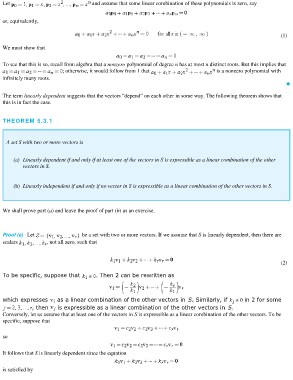
Let and assume that some linear combination of these polynomials is zero, say

or, equivalently,                                                                                                              (1)
We must show that

To see that this is so, recall from algebra that a nonzero polynomial of degree n has at most n distinct roots. But this implies that

                        ; otherwise, it would follow from 1 that         is a nonzero polynomial with

infinitely many roots.

The term linearly dependent suggests that the vectors “depend” on each other in some way. The following theorem shows that
this is in fact the case.

THEOREM 5.3.1

A set S with two or more vectors is

   (a) Linearly dependent if and only if at least one of the vectors in S is expressible as a linear combination of the other
         vectors in S.

   (b) Linearly independent if and only if no vector in S is expressible as a linear combination of the other vectors in S.

We shall prove part (a) and leave the proof of part (b) as an exercise.

Proof (a) Let                         be a set with two or more vectors. If we assume that S is linearly dependent, then there are
scalars            , not all zero, such that

                                                                                                                               (2)

To be specific, suppose that  . Then 2 can be rewritten as

which expresses as a linear combination of the other vectors in S. Similarly, if  in 2 for some

    , then is expressible as a linear combination of the other vectors in S.

Conversely, let us assume that at least one of the vectors in S is expressible as a linear combination of the other vectors. To be

specific, suppose that

so

It follows that S is linearly dependent since the equation

is satisfied by

