


Page 376 - Elementary_Linear_Algebra_with_Applications_Anton__9_edition
P. 376
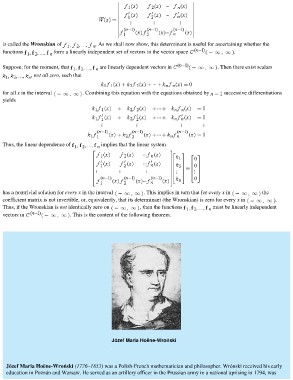
is called the Wronskian of                . As we shall now show, this determinant is useful for ascertaining whether the

functions                  form a linearly independent set of vectors in the vector space           .

Suppose, for the moment, that             are linearly dependent vectors in                         . Then there exist scalars
               , not all zero, such that

for all x in the interval                 . Combining this equation with the equations obtained by  successive differentiations
yields

Thus, the linear dependence of            implies that the linear system

has a nontrivial solution for every x in the interval  . This implies in turn that for every x in                    the

coefficient matrix is not invertible, or, equivalently, that its determinant (the Wronskian) is zero for every x in             .

Thus, if the Wronskian is not identically zero on      , then the functions                         must be linearly independent

vectors in                  . This is the content of the following theorem.

                                                                Józef Maria Hoëne-Wroński

Józef Maria Hoëne-Wroński (1776–1853) was a Polish-French mathematician and philosopher. Wrónski received his early
education in Poznán and Warsaw. He served as an artillery officer in the Prussian army in a national uprising in 1794, was

