


Page 373 - Elementary_Linear_Algebra_with_Applications_Anton__9_edition
P. 373
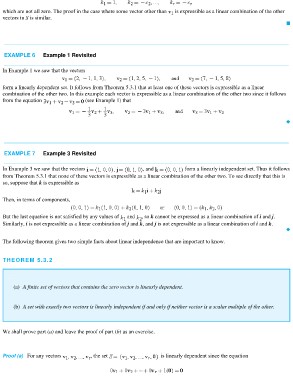
which are not all zero. The proof in the case where some vector other than is expressible as a linear combination of the other
vectors in S is similar.

EXAMPLE 6 Example 1 Revisited
In Example 1 we saw that the vectors

form a linearly dependent set. It follows from Theorem 5.3.1 that at least one of these vectors is expressible as a linear

combination of the other two. In this example each vector is expressible as a linear combination of the other two since it follows

from the equation                     (see Example 1) that

EXAMPLE 7 Example 3 Revisited

In Example 3 we saw that the vectors                        , and form a linearly independent set. Thus it follows

from Theorem 5.3.1 that none of these vectors is expressible as a linear combination of the other two. To see directly that this is

so, suppose that k is expressible as

Then, in terms of components,

But the last equation is not satisfied by any values of and , so k cannot be expressed as a linear combination of i and j.
Similarly, i is not expressible as a linear combination of j and k, and j is not expressible as a linear combination of i and k.

The following theorem gives two simple facts about linear independence that are important to know.

THEOREM 5.3.2

(a) A finite set of vectors that contains the zero vector is linearly dependent.
(b) A set with exactly two vectors is linearly independent if and only if neither vector is a scalar multiple of the other.

We shall prove part (a) and leave the proof of part (b) as an exercise.

Proof (a) For any vectors             , the set                          is linearly dependent since the equation

