


Page 384 - Elementary_Linear_Algebra_with_Applications_Anton__9_edition
P. 384
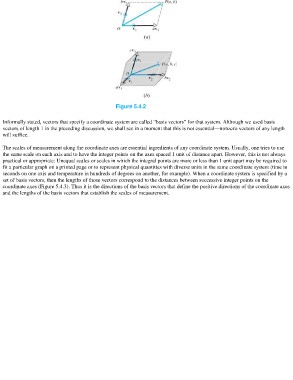
Figure 5.4.2

Informally stated, vectors that specify a coordinate system are called “basis vectors” for that system. Although we used basis
vectors of length 1 in the preceding discussion, we shall see in a moment that this is not essential—nonzero vectors of any length
will suffice.

The scales of measurement along the coordinate axes are essential ingredients of any coordinate system. Usually, one tries to use
the same scale on each axis and to have the integer points on the axes spaced 1 unit of distance apart. However, this is not always
practical or appropriate: Unequal scales or scales in which the integral points are more or less than 1 unit apart may be required to
fit a particular graph on a printed page or to represent physical quantities with diverse units in the same coordinate system (time in
seconds on one axis and temperature in hundreds of degrees on another, for example). When a coordinate system is specified by a
set of basis vectors, then the lengths of those vectors correspond to the distances between successive integer points on the
coordinate axes (Figure 5.4.3). Thus it is the directions of the basis vectors that define the positive directions of the coordinate axes
and the lengths of the basis vectors that establish the scales of measurement.

