


Page 388 - Elementary_Linear_Algebra_with_Applications_Anton__9_edition
P. 388
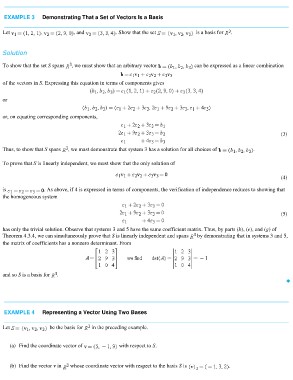
EXAMPLE 3 Demonstrating That a Set of Vectors Is a Basis                             is a basis for .
Let , , and . Show that the set

Solution                                                                             can be expressed as a linear combination

To show that the set S spans , we must show that an arbitrary vector

of the vectors in S. Expressing this equation in terms of components gives

or

or, on equating corresponding components,

                                                                                                          (3)

Thus, to show that S spans , we must demonstrate that system 3 has a solution for all choices of       .
To prove that S is linearly independent, we must show that the only solution of

                                                                                                                                                          (4)

is . As above, if 4 is expressed in terms of components, the verification of independence reduces to showing that
the homogeneous system

                                                                                                                                                          (5)

has only the trivial solution. Observe that systems 3 and 5 have the same coefficient matrix. Thus, by parts (b), (e), and (g) of
Theorem 4.3.4, we can simultaneously prove that S is linearly independent and spans by demonstrating that in systems 3 and 5,
the matrix of coefficients has a nonzero determinant. From

and so S is a basis for .

EXAMPLE 4 Representing a Vector Using Two Bases
Let be the basis for in the preceding example.

    (a) Find the coordinate vector of      with respect to S.

    (b) Find the vector v in whose coordinate vector with respect to the basis S is               .

