


Page 387 - Elementary_Linear_Algebra_with_Applications_Anton__9_edition
P. 387
Thus S is a basis for ; it is called the standard basis for . Looking at the coefficients of i, j, and k in 1, it follows that the
coordinates of v relative to the standard basis are a, b, and c, so

Comparing this result to 1, we see that

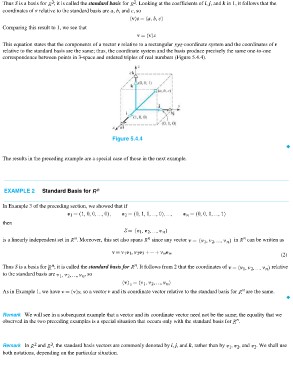
This equation states that the components of a vector v relative to a rectangular -coordinate system and the coordinates of v
relative to the standard basis are the same; thus, the coordinate system and the basis produce precisely the same one-to-one
correspondence between points in 3-space and ordered triples of real numbers (Figure 5.4.4).

                                                            Figure 5.4.4
The results in the preceding example are a special case of those in the next example.

EXAMPLE 2 Standard Basis for
In Example 3 of the preceding section, we showed that if

then

is a linearly independent set in . Moreover, this set also spans since any vector                        in can be written as

Thus S is a basis for ; it is called the standard basis for . It follows from 2 that the coordinates of       (2)
                                                                                                         relative

to the standard basis are  , so

As in Example 1, we have   , so a vector v and its coordinate vector relative to the standard basis for are the same.

Remark We will see in a subsequent example that a vector and its coordinate vector need not be the same; the equality that we
observed in the two preceding examples is a special situation that occurs only with the standard basis for .

Remark In and , the standard basis vectors are commonly denoted by i, j, and k, rather than by , , and . We shall use
both notations, depending on the particular situation.

