


Page 395 - Elementary_Linear_Algebra_with_Applications_Anton__9_edition
P. 395
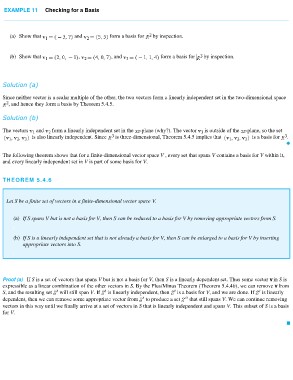
EXAMPLE 11 Checking for a Basis

(a) Show that  and form a basis for by inspection.
(b) Show that
               , , and           form a basis for by inspection.

Solution (a)

Since neither vector is a scalar multiple of the other, the two vectors form a linearly independent set in the two-dimensional space
   , and hence they form a basis by Theorem 5.4.5.

Solution (b)

The vectors and form a linearly independent set in the -plane (why?). The vector is outside of the -plane, so the set

is also linearly independent. Since is three-dimensional, Theorem 5.4.5 implies that  is a basis for .

The following theorem shows that for a finite-dimensional vector space V , every set that spans V contains a basis for V within it,
and every linearly independent set in V is part of some basis for V.

THEOREM 5.4.6

Let S be a finite set of vectors in a finite-dimensional vector space V.

   (a) If S spans V but is not a basis for V, then S can be reduced to a basis for V by removing appropriate vectors from S.

   (b) If S is a linearly independent set that is not already a basis for V, then S can be enlarged to a basis for V by inserting
         appropriate vectors into S.

Proof (a) If S is a set of vectors that spans V but is not a basis for V, then S is a linearly dependent set. Thus some vector v in S is
expressible as a linear combination of the other vectors in S. By the Plus/Minus Theorem (Theorem 5.4.4b), we can remove v from
S, and the resulting set will still span V. If is linearly independent, then is a basis for V, and we are done. If is linearly
dependent, then we can remove some appropriate vector from to produce a set that still spans V. We can continue removing
vectors in this way until we finally arrive at a set of vectors in S that is linearly independent and spans V. This subset of S is a basis
for V.

