


Page 394 - Elementary_Linear_Algebra_with_Applications_Anton__9_edition
P. 394
We shall defer the proof to the end of the section, so that we may move more immediately to the consequences of the theorem.
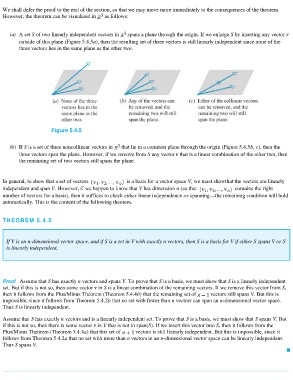
However, the theorem can be visualized in as follows:

   (a) A set S of two linearly independent vectors in spans a plane through the origin. If we enlarge S by inserting any vector v
         outside of this plane (Figure 5.4.5a), then the resulting set of three vectors is still linearly independent since none of the
         three vectors lies in the same plane as the other two.

                       Figure 5.4.5

(b) If S is a set of three noncollinear vectors in that lie in a common plane through the origin (Figure 5.4.5b, c), then the
     three vectors span the plane. However, if we remove from S any vector v that is a linear combination of the other two, then
     the remaining set of two vectors still spans the plane.

In general, to show that a set of vectors             is a basis for a vector space V, we must showthat the vectors are linearly

independent and span V. However, if we happen to know that V has dimension n (so that   contains the right

number of vectors for a basis), then it suffices to check either linear independence or spanning—the remaining condition will hold

automatically. This is the content of the following theorem.

THEOREM 5.4.5

If V is an n-dimensional vector space, and if S is a set in V with exactly n vectors, then S is a basis for V if either S spans V or S
is linearly independent.

Proof Assume that S has exactly n vectors and spans V. To prove that S is a basis, we must show that S is a linearly independent

set. But if this is not so, then some vector v in S is a linear combination of the remaining vectors. If we remove this vector from S,

then it follows from the Plus/Minus Theorem (Theorem 5.4.4b) that the remaining set of  vectors still spans V. But this is

impossible, since it follows from Theorem 5.4.2b that no set with fewer than n vectors can span an n-dimensional vector space.

Thus S is linearly independent.

Assume that S has exactly n vectors and is a linearly independent set. To prove that S is a basis, we must show that S spans V. But

if this is not so, then there is some vector v in V that is not in span(S). If we insert this vector into S, then it follows from the

Plus/Minus Theorem (Theorem 5.4.4a) that this set of          vectors is still linearly independent. But this is impossible, since it

follows from Theorem 5.4.2a that no set with more than n vectors in an n-dimensional vector space can be linearly independent.

Thus S spans V.

