


Page 392 - Elementary_Linear_Algebra_with_Applications_Anton__9_edition
P. 392
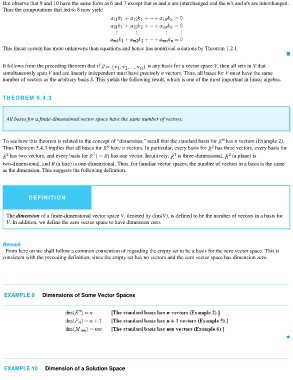
But observe that 9 and 10 have the same form as 6 and 7 except that m and n are interchanged and the w's and v's are interchanged.
Thus the computations that led to 8 now yield

This linear system has more unknowns than equations and hence has nontrivial solutions by Theorem 1.2.1.

It follows from the preceding theorem that if  is any basis for a vector space V, then all sets in V that

simultaneously span V and are linearly independent must have precisely n vectors. Thus, all bases for V must have the same

number of vectors as the arbitrary basis S. This yields the following result, which is one of the most important in linear algebra.

THEOREM 5.4.3

All bases for a finite-dimensional vector space have the same number of vectors.

To see how this theorem is related to the concept of “dimension,” recall that the standard basis for has n vectors (Example 2).
Thus Theorem 5.4.3 implies that all bases for have n vectors. In particular, every basis for has three vectors, every basis for

has two vectors, and every basis for           has one vector. Intuitively, is three-dimensional, (a plane) is

two-dimensional, and R (a line) is one-dimensional. Thus, for familiar vector spaces, the number of vectors in a basis is the same
as the dimension. This suggests the following definition.

              DEFINITION

  The dimension of a finite-dimensional vector space V, denoted by dim(V), is defined to be the number of vectors in a basis for
  V. In addition, we define the zero vector space to have dimension zero.

Remark

 From here on we shall follow a common convention of regarding the empty set to be a basis for the zero vector space. This is
consistent with the preceding definition, since the empty set has no vectors and the zero vector space has dimension zero.

EXAMPLE 9 Dimensions of Some Vector Spaces

EXAMPLE 10 Dimension of a Solution Space

