


Page 393 - Elementary_Linear_Algebra_with_Applications_Anton__9_edition
P. 393
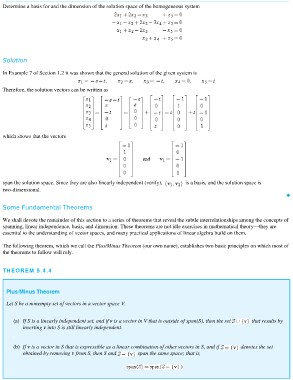
Determine a basis for and the dimension of the solution space of the homogeneous system

Solution

In Example 7 of Section 1.2 it was shown that the general solution of the given system is

Therefore, the solution vectors can be written as

which shows that the vectors

span the solution space. Since they are also linearly independent (verify),  is a basis, and the solution space is
two-dimensional.

Some Fundamental Theorems

We shall devote the remainder of this section to a series of theorems that reveal the subtle interrelationships among the concepts of
spanning, linear independence, basis, and dimension. These theorems are not idle exercises in mathematical theory—they are
essential to the understanding of vector spaces, and many practical applications of linear algebra build on them.

The following theorem, which we call the Plus/Minus Theorem (our own name), establishes two basic principles on which most of
the theorems to follow will rely.

THEOREM 5.4.4

Plus/Minus Theorem                                                                                             that results by
Let S be a nonempty set of vectors in a vector space V.

   (a) If S is a linearly independent set, and if v is a vector in V that is outside of span(S), then the set
         inserting v into S is still linearly independent.

(b) If v is a vector in S that is expressible as a linear combination of other vectors in S, and if            denotes the set

obtained by removing v from S, then S and  span the same space; that is,

