


Page 396 - Elementary_Linear_Algebra_with_Applications_Anton__9_edition
P. 396
Proof (b) Suppose that               . If S is a linearly independent set that is not already a basis for V, then S fails to span V, and

there is some vector v in V that is not in span(S). By the Plus/Minus Theorem (Theorem 5.4.4a), we can insert v into S, and the

resulting set will still be linearly independent. If spans V, then is a basis for V, and we are finished. If does not span V,

then we can insert an appropriate vector into to produce a set that is still linearly independent. We can continue inserting

vectors in this way until we reach a set with n linearly independent vectors in V. This set will be a basis for V by Theorem 5.4.5.

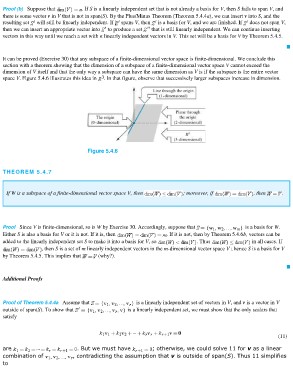
It can be proved (Exercise 30) that any subspace of a finite-dimensional vector space is finite-dimensional. We conclude this
section with a theorem showing that the dimension of a subspace of a finite-dimensional vector space V cannot exceed the
dimension of V itself and that the only way a subspace can have the same dimension as V is if the subspace is the entire vector
space V. Figure 5.4.6 illustrates this idea in . In that figure, observe that successively larger subspaces increase in dimension.

                                               Figure 5.4.6                ; moreover, if       , then                                  .
THEOREM 5.4.7

  If W is a subspace of a finite-dimensional vector space V, then

Proof Since V is finite-dimensional, so is W by Exercise 30. Accordingly, suppose that          is a basis for W.

Either S is also a basis for V or it is not. If it is, then                . If it is not, then by Theorem 5.4.6b, vectors can be

added to the linearly independent set S to make it into a basis for V, so               . Thus  in all cases. If

, then S is a set of m linearly independent vectors in the m-dimensional vector space V ; hence S is a basis for V

by Theorem 5.4.5. This implies that  (why?).

Additional Proofs

Proof of Theorem 5.4.4a Assume that                              is a linearly independent set of vectors in V, and v is a vector in V
outside of span(S). To show that                             is a linearly independent set, we must show that the only scalars that
satisfy

                                                                                                        (11)

are                     . But we must have                         ; otherwise, we could solve 11 for v as a linear
combination of
to                      , contradicting the assumption that v is outside of span(S). Thus 11 simplifies

