


Page 487 - Elementary_Linear_Algebra_with_Applications_Anton__9_edition
P. 487
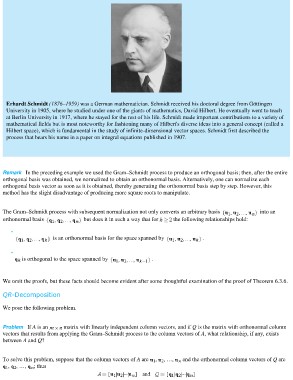
Erhardt Schmidt (1876–1959) was a German mathematician. Schmidt received his doctoral degree from Göttingen
University in 1905, where he studied under one of the giants of mathematics, David Hilbert. He eventually went to teach
at Berlin University in 1917, where he stayed for the rest of his life. Schmidt made important contributions to a variety of
mathematical fields but is most noteworthy for fashioning many of Hilbert's diverse ideas into a general concept (called a
Hilbert space), which is fundamental in the study of infinite-dimensional vector spaces. Schmidt first described the
process that bears his name in a paper on integral equations published in 1907.

Remark In the preceding example we used the Gram–Schmidt process to produce an orthogonal basis; then, after the entire
orthogonal basis was obtained, we normalized to obtain an orthonormal basis. Alternatively, one can normalize each
orthogonal basis vector as soon as it is obtained, thereby generating the orthonormal basis step by step. However, this
method has the slight disadvantage of producing more square roots to manipulate.

The Gram–Schmidt process with subsequent normalization not only converts an arbitrary basis              into an

orthonormal basis   but does it in such a way that for                the following relationships hold:

                    is an orthonormal basis for the space spanned by  .

is orthogonal to the space spanned by  .

We omit the proofs, but these facts should become evident after some thoughtful examination of the proof of Theorem 6.3.6.

QR-Decomposition

We pose the following problem.

Problem If A is an  matrix with linearly independent column vectors, and if Q is the matrix with orthonormal column

vectors that results from applying the Gram–Schmidt process to the column vectors of A, what relationship, if any, exists

between A and Q?

To solve this problem, suppose that the column vectors of A are , , …, and the orthonormal column vectors of Q are
  , , …, ; thus

