


Page 488 - Elementary_Linear_Algebra_with_Applications_Anton__9_edition
P. 488
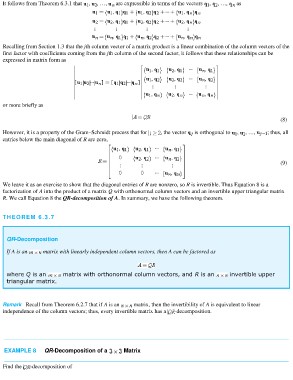
It follows from Theorem 6.3.1 that , , …, are expressible in terms of the vectors , , …, as

Recalling from Section 1.3 that the jth column vector of a matrix product is a linear combination of the column vectors of the
first factor with coefficients coming from the jth column of the second factor, it follows that these relationships can be
expressed in matrix form as

or more briefly as                                              , the vector is orthogonal to , , …,                (8)
                                                                                                              ; thus, all
However, it is a property of the Gram–Schmidt process that for
entries below the main diagonal of R are zero,

                                                                                                              (9)

We leave it as an exercise to show that the diagonal entries of R are nonzero, so R is invertible. Thus Equation 8 is a
factorization of A into the product of a matrix Q with orthonormal column vectors and an invertible upper triangular matrix
R. We call Equation 8 the QR-decomposition of A. In summary, we have the following theorem.

THEOREM 6.3.7

QR-Decomposition

If A is an  matrix with linearly independent column vectors, then A can be factored as

where Q is an       matrix with orthonormal column vectors, and R is an                 invertible upper

triangular matrix.

Remark Recall from Theorem 6.2.7 that if A is an matrix, then the invertibility of A is equivalent to linear
independence of the column vectors; thus, every invertible matrix has a -decomposition.

EXAMPLE 8 QR-Decomposition of a  Matrix
Find the -decomposition of

