


Page 490 - Elementary_Linear_Algebra_with_Applications_Anton__9_edition
P. 490
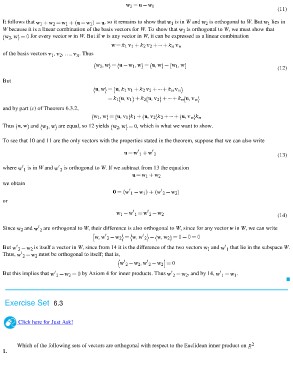
(11)

It follows that                     , so it remains to show that is in W and is orthogonal to W. But lies in

W because it is a linear combination of the basis vectors for W. To show that is orthogonal to W, we must show that

       for every vector w in W. But if w is any vector in W, it can be expressed as a linear combination

of the basis vectors , , …, . Thus                                                                                    (12)
But

and by part (c) of Theorem 6.3.2,

Thus   and             are equal, so 12 yields  , which is what we want to show.

To see that 10 and 11 are the only vectors with the properties stated in the theorem, suppose that we can also write

                                                                                                                      (13)

where is in W and is orthogonal to W. If we subtract from 13 the equation
we obtain

or

Since and                                                                                                                                    (14)
                 are orthogonal to W, their difference is also orthogonal to W, since for any vector w in W, we can write

But        is itself a vector in W, since from 14 it is the difference of the two vectors and that lie in the subspace W.
Thus,        must be orthogonal to itself; that is,

But this implies that              by Axiom 4 for inner products. Thus  , and by 14,  .

Exercise Set 6.3

        Click here for Just Ask!

       Which of the following sets of vectors are orthogonal with respect to the Euclidean inner product on
1.

