


Page 559 - Elementary_Linear_Algebra_with_Applications_Anton__9_edition
P. 559
Thus the eigenspace corresponding to         is at most (hence exactly) one-dimensional, and the eigenspace corresponding to

is at most two-dimensional. In Example 1 the eigenspace corresponding to  actually had dimension 2, resulting in

diagonalizability,but in Example 2 that eigenspace had only dimension 1, resulting in nondiagonalizability.

There is some terminology that is related to these ideas. If is an eigenvalue of an matrix A, then the dimension of the

eigenspace corresponding to is called the geometric multiplicity of , and the number of times that           appears as a factor

in the characteristic polynomial of A is called the algebraic multiplicity of A. The following theorem, which we state without

proof, summarizes the preceding discussion.

THEOREM 7.2.4

Geometric and Algebraic Multiplicity
If A is a square matrix, then

   (a) For every eigenvalue of A, the geometric multiplicity is less than or equal to the algebraic multiplicity.

   (b) A is diagonalizable if and only if, for every eigenvalue, the geometric multiplicity is equal to the algebraic
        multiplicity.

Computing Powers of a Matrix

There are numerous problems in applied mathematics that require the computation of high powers of a square matrix. We shall
conclude this section by showing how diagonalization can be used to simplify such computations for diagonalizable matrices.

If A is an matrix and P is an invertible matrix, then

More generally, for any positive integer k,

                                                                                                                       (8)

It follows from this equation that if A is diagonalizable, and  is a diagonal matrix, then

                                                                                                                       (9)

Solving this equation for yields

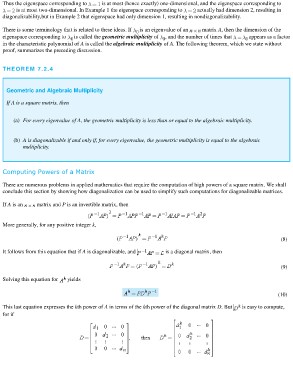
This last equation expresses the kth power of A in terms of the kth power of the diagonal matrix D. But                         (10)
for if                                                                                                       is easy to compute,

