


Page 61 - Elementary_Linear_Algebra_with_Applications_Anton__9_edition
P. 61
(a) The expressions and are always defined, regardless of the size of A.

         (b) for every matrix A.

         (c) If the first column of A has all zeros, then so does the first column of every product .
         (d) If the first row of A has all zeros, then so does the first row of every product .

     Indicate whether the statement is always true or sometimes false. Justify your answer with a
32. logical argument or a counterexample.

(a) If A is a square matrix with two identical rows, then AA has two identical rows.

(b) If A is a square matrix and AA has a column of zeros, then A must have a column of
     zeros.

(c) If B is an matrix whose entries are positive even integers, and if A is an
     matrix whose entries are positive integers, then the entries of AB and BA are positive
     even integers.

(d) If the matrix sum        is defined, then A and B must be square.

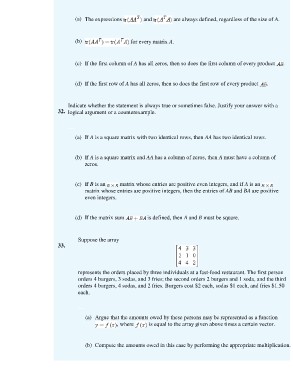
          Suppose the array
33.

represents the orders placed by three individuals at a fast-food restaurant. The first person
orders 4 burgers, 3 sodas, and 3 fries; the second orders 2 burgers and 1 soda, and the third
orders 4 burgers, 4 sodas, and 2 fries. Burgers cost $2 each, sodas $1 each, and fries $1.50
each.

(a) Argue that the amounts owed by these persons may be represented as a function

, where                      is equal to the array given above times a certain vector.

(b) Compute the amounts owed in this case by performing the appropriate multiplication.

