


Page 64 - Elementary_Linear_Algebra_with_Applications_Anton__9_edition
P. 64
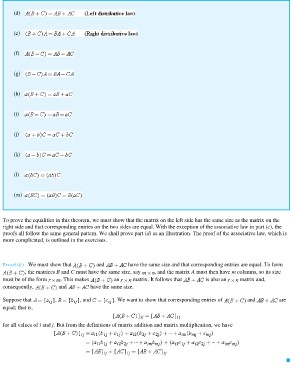
(d)
(e)
(f)
(g)
(h)
(i)
(j)
(k)
(l)
(m)

To prove the equalities in this theorem, we must show that the matrix on the left side has the same size as the matrix on the
right side and that corresponding entries on the two sides are equal. With the exception of the associative law in part (c), the
proofs all follow the same general pattern. We shall prove part (d) as an illustration. The proof of the associative law, which is
more complicated, is outlined in the exercises.

Proof (d) We must show that       and have the same size and that corresponding entries are equal. To form

     , the matrices B and C must have the same size, say , and the matrix A must then have m columns, so its size

must be of the form . This makes  an matrix. It follows that  is also an matrix and,

consequently,  and have the same size.

Suppose that , , and . We want to show that corresponding entries of                                       and are
equal; that is,

for all values of i and j. But from the definitions of matrix addition and matrix multiplication, we have

