


Page 65 - Elementary_Linear_Algebra_with_Applications_Anton__9_edition
P. 65
Remark Although the operations of matrix addition and matrix multiplication were defined for pairs of matrices, associative

laws (b) and (c) enable us to denote sums and products of three matrices as    and ABC without inserting any

parentheses. This is justified by the fact that no matter how parentheses are inserted, the associative laws guarantee that the

same end result will be obtained. In general, given any sum or any product of matrices, pairs of parentheses can be inserted or

deleted anywhere within the expression without affecting the end result.

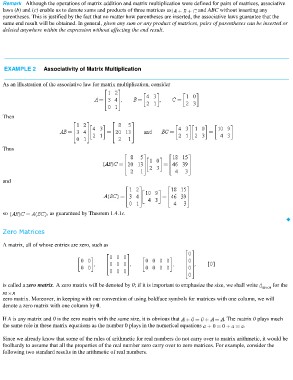
EXAMPLE 2 Associativity of Matrix Multiplication
As an illustration of the associative law for matrix multiplication, consider

Then

Thus

and

so , as guaranteed by Theorem 1.4.1c.

Zero Matrices

A matrix, all of whose entries are zero, such as

is called a zero matrix. A zero matrix will be denoted by 0; if it is important to emphasize the size, we shall write for the

zero matrix. Moreover, in keeping with our convention of using boldface symbols for matrices with one column, we will
denote a zero matrix with one column by 0.

If A is any matrix and 0 is the zero matrix with the same size, it is obvious that        . The matrix 0 plays much
the same role in these matrix equations as the number 0 plays in the numerical equations            .

Since we already know that some of the rules of arithmetic for real numbers do not carry over to matrix arithmetic, it would be
foolhardy to assume that all the properties of the real number zero carry over to zero matrices. For example, consider the
following two standard results in the arithmetic of real numbers.

