


Page 66 - Elementary_Linear_Algebra_with_Applications_Anton__9_edition
P. 66
If and , then . (This is called the cancellation law.)
      If , then at least one of the factors on the left is 0.
As the next example shows, the corresponding results are not generally true in matrix arithmetic.

EXAMPLE 3 The Cancellation Law Does Not Hold
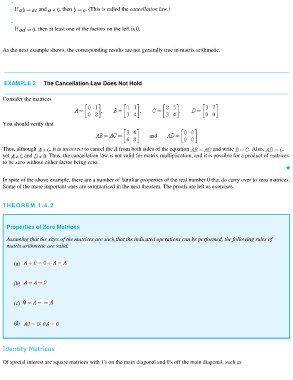
Consider the matrices

You should verify that

Thus, although , it is incorrect to cancel the A from both sides of the equation  and write                   . Also,    ,

yet and . Thus, the cancellation law is not valid for matrix multiplication, and it is possible for a product of matrices

to be zero without either factor being zero.

In spite of the above example, there are a number of familiar properties of the real number 0 that do carry over to zero matrices.
Some of the more important ones are summarized in the next theorem. The proofs are left as exercises.

THEOREM 1.4.2

Properties of Zero Matrices
Assuming that the sizes of the matrices are such that the indicated operations can be performed, the following rules of
matrix arithmetic are valid.

   (a)

   (b)

   (c)

   (d) ;

Identity Matrices

Of special interest are square matrices with 1's on the main diagonal and 0's off the main diagonal, such as

