


Page 63 - Elementary_Linear_Algebra_with_Applications_Anton__9_edition
P. 63
1.4                                      In this section we shall discuss some properties of the arithmetic operations
                                         on matrices. We shall see that many of the basic rules of arithmetic for real
INVERSES; RULES OF                       numbers also hold for matrices, but a few do not.
MATRIX ARITHMETIC

Properties of Matrix Operations

For real numbers a and b, we always have  , which is called the commutative law for multiplication. For matrices,

however, AB and BA need not be equal. Equality can fail to hold for three reasons: It can happen that the product AB is defined

but BA is undefined. For example, this is the case if A is a matrix and B is a matrix. Also, it can happen that AB and

BA are both defined but have different sizes. This is the situation if A is a matrix and B is a matrix. Finally, as

Example 1 shows, it is possible to have   even if both AB and BA are defined and have the same size.

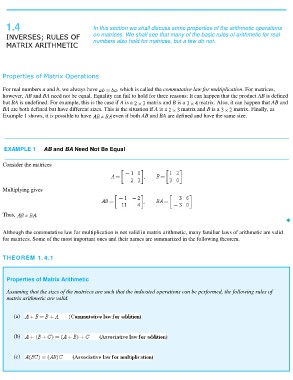
EXAMPLE 1 AB and BA Need Not Be Equal
Consider the matrices

Multiplying gives

Thus,  .

Although the commutative law for multiplication is not valid in matrix arithmetic, many familiar laws of arithmetic are valid
for matrices. Some of the most important ones and their names are summarized in the following theorem.

THEOREM 1.4.1

Properties of Matrix Arithmetic
Assuming that the sizes of the matrices are such that the indicated operations can be performed, the following rules of
matrix arithmetic are valid.

   (a)

   (b)

   (c)

