


Page 707 - Elementary_Linear_Algebra_with_Applications_Anton__9_edition
P. 707
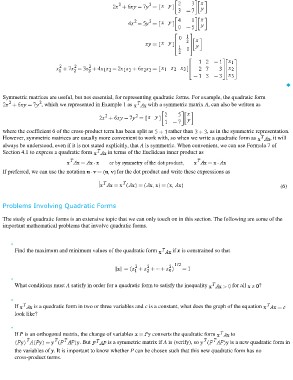
Symmetric matrices are useful, but not essential, for representing quadratic forms. For example, the quadratic form

, which we represented in Example 1 as                 with a symmetric matrix A, can also be written as

where the coefficient 6 of the cross-product term has been split as  rather than , as in the symmetric representation.

However, symmetric matrices are usually more convenient to work with, so when we write a quadratic form as , it will

always be understood, even if it is not stated explicitly, that A is symmetric. When convenient, we can use Formula 7 of

Section 4.1 to express a quadratic form  in terms of the Euclidean inner product as

If preferred, we can use the notation    for the dot product and write these expressions as

                                                                                                                          (6)

Problems Involving Quadratic Forms

The study of quadratic forms is an extensive topic that we can only touch on in this section. The following are some of the
important mathematical problems that involve quadratic forms.

Find the maximum and minimum values of the quadratic form            if x is constrained so that

What conditions must A satisfy in order for a quadratic form to satisfy the inequality            for all ?

If is a quadratic form in two or three variables and c is a constant, what does the graph of the equation
look like?

If P is an orthogonal matrix, the change of variables  converts the quadratic form                to

. But is a symmetric matrix if A is (verify), so                                                  is a new quadratic form in

the variables of y. It is important to know whether P can be chosen such that this new quadratic form has no
cross-product terms.

