


Page 711 - Elementary_Linear_Algebra_with_Applications_Anton__9_edition
P. 711
negative definite              if  for

                negative semidefinite if           for all x

                indefinite                     if has both positive and negative values

Theorems Theorem 9.5.2 and Theorem 9.5.3 can be modified in an obvious way to apply to matrices of the first three types.
For example, a symmetric matrix A is positive semidefinite if and only if all of its eigenvalues are nonnegative. Also, A is
positive semidefinite if and only if all its principal submatrices have nonnegative determinants.

Optional

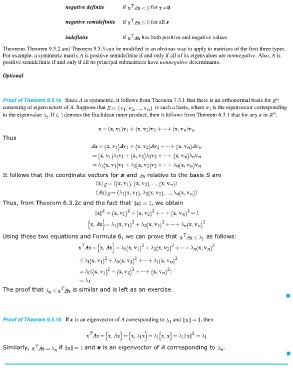
Proof of Theorem 9.5.1a Since A is symmetric, it follows from Theorem 7.3.1 that there is an orthonormal basis for

consisting of eigenvectors of A. Suppose that      is such a basis, where is the eigenvector corresponding

to the eigenvalue . If , denotes the Euclidean inner product, then it follows from Theorem 6.3.1 that for any x in ,

Thus

It follows that the coordinate vectors for x and relative to the basis S are

Thus, from Theorem 6.3.2c and the fact that        , we obtain

Using these two equations and Formula 6, we can prove that                as follows:

The proof that  is similar and is left as an exercise.

Proof of Theorem 9.5.1b If x is an eigenvector of A corresponding to and  , then

Similarly,      if and x is an eigenvector of A corresponding to .

