


Page 708 - Elementary_Linear_Algebra_with_Applications_Anton__9_edition
P. 708
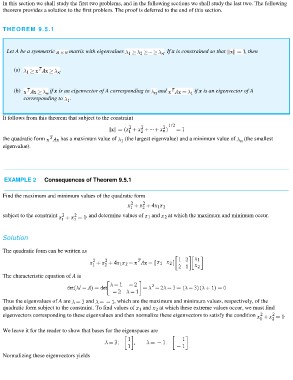
In this section we shall study the first two problems, and in the following sections we shall study the last two. The following
theorem provides a solution to the first problem. The proof is deferred to the end of this section.

THEOREM 9.5.1

Let A be a symmetric matrix with eigenvalues                           . If x is constrained so that  , then
   (a) .

(b) if x is an eigenvector of A corresponding to and                   if x is an eigenvector of A
     corresponding to .

It follows from this theorem that subject to the constraint

the quadratic form         has a maximum value of (the largest eigenvalue) and a minimum value of (the smallest
eigenvalue).

EXAMPLE 2 Consequences of Theorem 9.5.1
Find the maximum and minimum values of the quadratic form

subject to the constraint            , and determine values of and at which the maximum and minimum occur.

Solution

The quadratic form can be written as

The characteristic equation of A is

Thus the eigenvalues of A are        and  , which are the maximum and minimum values, respectively, of the

quadratic form subject to the constraint. To find values of and at which these extreme values occur, we must find

eigenvectors corresponding to these eigenvalues and then normalize these eigenvectors to satisfy the condition     .

We leave it for the reader to show that bases for the eigenspaces are

Normalizing these eigenvectors yields

