


Page 825 - Elementary_Linear_Algebra_with_Applications_Anton__9_edition
P. 825
10.6                     For matrices with real entries, the orthogonal matrices                       and the

UNITARY, NORMAL,         symmetric matrices                     played an important role in the orthogonal
AND HERMITIAN
MATRICES                 diagonalization problem (Section 7.3). For matrices with complex entries, the

                         orthogonal and symmetric matrices are of little importance; they are

                         superseded by two new classes of matrices, the unitary and Hermitian

                         matrices, which we shall discuss in this section.

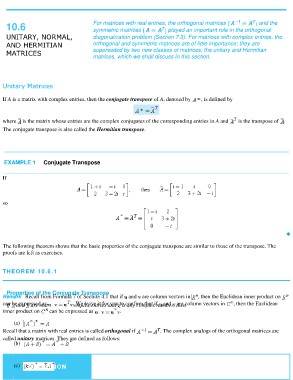
Unitary Matrices                                                                      , is defined by

If A is a matrix with complex entries, then the conjugate transpose of A, denoted by

where is the matrix whose entries are the complex conjugates of the corresponding entries in A and is the transpose of .
The conjugate transpose is also called the Hermitian transpose.

EXAMPLE 1 Conjugate Transpose
If

so

The following theorem shows that the basic properties of the conjugate transpose are similar to those of the transpose. The
proofs are left as exercises.

THEOREM 10.6.1

RePmroaprkertRieescaollfftrhome CFoornmjuulgaa7teofTSreacntisopno4s.1e that if and are column vectors in , then the Euclidean inner product on

caInf beaenxdpreassreedmaastrices with c.oWmpelleexavenetirtiefosraynodu toiscaonnyficrmomtphlaetxifnumanbder, tahreencolumn vectors in , then the Euclidean

inner product on can be expressed as  .

     (a)                                                        . The complex analogs of the orthogonal matrices are
Recall that a matrix with real entries is called orthogonal if
called unitary matrices. They are defined as follows:

     (b)

(c) D E F I N I T I O N

