


Page 829 - Elementary_Linear_Algebra_with_Applications_Anton__9_edition
P. 829
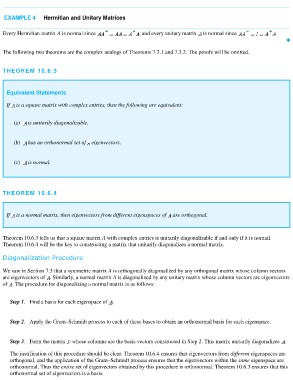
EXAMPLE 4 Hermitian and Unitary Matrices  , and every unitary matrix is normal since                         .
Every Hermitian matrix A is normal since

The following two theorems are the complex analogs of Theorems 7.3.1 and 7.3.2. The proofs will be omitted.

THEOREM 10.6.3

Equivalent Statements
If is a square matrix with complex entries, then the following are equivalent:

   (a) is unitarily diagonalizable.
   (b) has an orthonormal set of eigenvectors.
   (c) is normal.

THEOREM 10.6.4

  If is a normal matrix, then eigenvectors from different eigenspaces of are orthogonal.

Theorem 10.6.3 tells us that a square matrix A with complex entries is unitarily diagonalizable if and only if it is normal.
Theorem 10.6.4 will be the key to constructing a matrix that unitarily diagonalizes a normal matrix.

Diagonalization Procedure

We saw in Section 7.3 that a symmetric matrix A is orthogonally diagonalized by any orthogonal matrix whose column vectors
are eigenvectors of . Similarly, a normal matrix A is diagonalized by any unitary matrix whose column vectors are eigenvectors
of . The procedure for diagonalizing a normal matrix is as follows:

   Step 1. Find a basis for each eigenspace of .

   Step 2. Apply the Gram–Schmidt process to each of these bases to obtain an orthonormal basis for each eigenspace.

   Step 3. Form the matrix whose columns are the basis vectors constructed in Step 2. This matrix unitarily diagonalizes .
   The justification of this procedure should be clear. Theorem 10.6.4 ensures that eigenvectors from different eigenspaces are
   orthogonal, and the application of the Gram–Schmidt process ensures that the eigenvectors within the same eigenspace are
   orthonormal. Thus the entire set of eigenvectors obtained by this procedure is orthonormal. Theorem 10.6.3 ensures that this
   orthonormal set of eigenvectors is a basis.

