


Page 828 - Elementary_Linear_Algebra_with_Applications_Anton__9_edition
P. 828
In Section 7.3 we saw that the problem of orthogonally diagonalizing a matrix with real entries led to consideration of the
symmetric matrices. The most natural complex analogs of the real symmetric matrices are the Hermitian matrices, which are
defined as follows:

             DEFINITION

  A square matrix A with complex entries is called Hermitian if

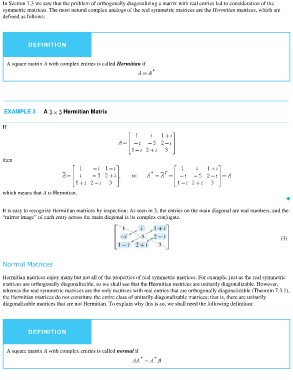
EXAMPLE 3 A  Hermitian Matrix
If

then

which means that A is Hermitian.

It is easy to recognize Hermitian matrices by inspection: As seen in 3, the entries on the main diagonal are real numbers, and the
“mirror image” of each entry across the main diagonal is its complex conjugate.

                                                                                                                                                       (3)

Normal Matrices

Hermitian matrices enjoy many but not all of the properties of real symmetric matrices. For example, just as the real symmetric
matrices are orthogonally diagonalizable, so we shall see that the Hermitian matrices are unitarily diagonalizable. However,
whereas the real symmetric matrices are the only matrices with real entries that are orthogonally diagonalizable (Theorem 7.3.1),
the Hermitian matrices do not constitute the entire class of unitarily diagonalizable matrices; that is, there are unitarily
diagonalizable matrices that are not Hermitian. To explain why this is so, we shall need the following definition:

             DEFINITION

  A square matrix A with complex entries is called normal if

