


Page 870 - Elementary_Linear_Algebra_with_Applications_Anton__9_edition
P. 870
11.4               Linear systems can be found in the earliest writings of many ancient
                   civilizations. We give some examples of the types of problems that they used to
THE EARLIEST       solve.
APPLICATIONS OF
LINEAR ALGEBRA

                                                           Prerequisites: Linear Systems

The practical problems of early civilizations included the measurement of land, the distribution of goods, the tracking of resources
such as wheat and cattle, and taxation and inheritance calculations. In many cases, these problems led to linear systems of
equations since linearity is one of the simplest relationship that can exist among variables. In this section we present examples
from five diverse ancient cultures illustrating how they used and solved systems of linear equations. We restrict ourselves to
examples before A.D. 500. These examples consequently predate the development, by Islamic/Arab mathematicians, of the field of
algebra, a field that ultimately led, in the nineteenth century, to the branch of mathematics now called linear algebra.

EXAMPLE 1 Egypt (about 1650 B.C.)

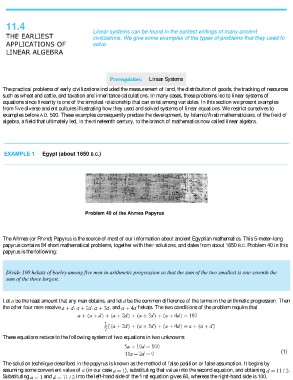
                   Problem 40 of the Ahmes Papyrus

The Ahmes (or Rhind) Papyrus is the source of most of our information about ancient Egyptian mathematics. This 5-meter-long
papyrus contains 84 short mathematical problems, together with their solutions, and dates from about 1650 B.C. Problem 40 in this
papyrus is the following:

 Divide 100 hekats of barley among five men in arithmetic progression so that the sum of the two smallest is one-seventh the
 sum of the three largest.

Let a be the least amount that any man obtains, and let d be the common difference of the terms in the arithmetic progression. Then

the other four men receive , , , and  hekats. The two conditions of the problem require that

These equations reduce to the following system of two equations in two unknowns:

The solution technique described in the papyrus is known as the method of false position or false assumption. It begins by  (1)
                                                                                                                                .
assuming some convenient value of a (in our case ), substituting that value into the second equation, and obtaining

Substituting  and  into the left-hand side of the first equation gives 60, whereas the right-hand side is 100.

