


Page 875 - Elementary_Linear_Algebra_with_Applications_Anton__9_edition
P. 875
(4)

where k is any real number. The values  , 2, … give infinitely many positive integer solutions to the problem, with
giving the smallest solution.

EXAMPLE 5 India (fourth century A.D.)

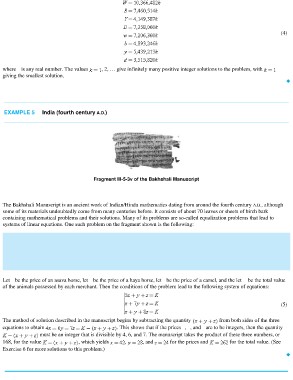
                                        Fragment III-5-3v of the Bakhshali Manuscript

The Bakhshali Manuscript is an ancient work of Indian/Hindu mathematics dating from around the fourth century A.D., although
some of its materials undoubtedly come from many centuries before. It consists of about 70 leaves or sheets of birch bark
containing mathematical problems and their solutions. Many of its problems are so-called equalization problems that lead to
systems of linear equations. One such problem on the fragment shown is the following:

 One merchant has seven asava horses, a second has nine haya horses, and a third has ten camels. They are equally well off in
 the value of their animals if each gives two animals, one to each of the others. Find the price of each animal and the total value
 of the animals possessed by each merchant.

Let x be the price of an asava horse, let y be the price of a haya horse, let z be the price of a camel, and the let K be the total value
of the animals possessed by each merchant. Then the conditions of the problem lead to the following system of equations:

                                                                                                                     (5)

The method of solution described in the manuscript begins by subtracting the quantity  from both sides of the three

equations to obtain                              . This shows that if the prices x, y, and z are to be integers, then the quantity

must be an integer that is divisible by 4, 6, and 7. The manuscript takes the product of these three numbers, or

168, for the value   , which yields , , and for the prices and                         for the total value. (See

Exercise 6 for more solutions to this problem.)

