


Page 871 - Elementary_Linear_Algebra_with_Applications_Anton__9_edition
P. 871
Adjusting the initial guess for a by multiplying it by 100/60 leads to the correct value  . Substituting  into the

second equation then gives  , so the quantities of barley received by the five men are 10/6, 65/6, 120/6, 175/6, and 230/6

hekats. This technique of guessing a value of an unknown and later adjusting it has been used by many cultures throughout the

ages.

EXAMPLE 2 Babylonia (1900–1600 B.C.)

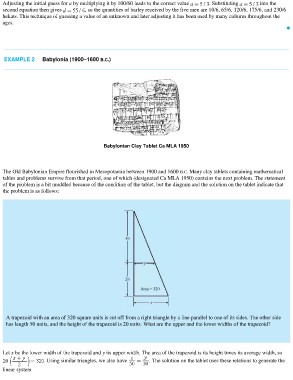
                                                              Babylonian Clay Tablet Ca MLA 1950

The Old Babylonian Empire flourished in Mesopotamia between 1900 and 1600 B.C. Many clay tablets containing mathematical
tables and problems survive from that period, one of which (designated Ca MLA 1950) contains the next problem. The statement
of the problem is a bit muddled because of the condition of the tablet, but the diagram and the solution on the tablet indicate that
the problem is as follows:

A trapezoid with an area of 320 square units is cut off from a right triangle by a line parallel to one of its sides. The other side
has length 50 units, and the height of the trapezoid is 20 units. What are the upper and the lower widths of the trapezoid?

Let x be the lower width of the trapezoid and y its upper width. The area of the trapezoid is its height times its average width, so

               . Using similar triangles, we also have  . The solution on the tablet uses these relations to generate the

linear system

