


Page 874 - Elementary_Linear_Algebra_with_Applications_Anton__9_edition
P. 874
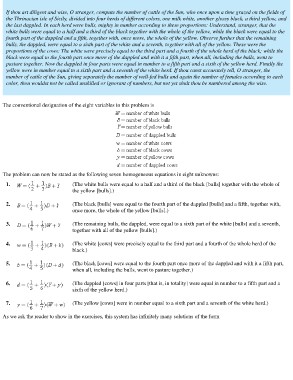
If thou art diligent and wise, O stranger, compute the number of cattle of the Sun, who once upon a time grazed on the fields of
 the Thrinacian isle of Sicily, divided into four herds of different colors, one milk white, another glossy black, a third yellow, and
 the last dappled. In each herd were bulls, mighty in number according to these proportions: Understand, stranger, that the
 white bulls were equal to a half and a third of the black together with the whole of the yellow, while the black were equal to the
 fourth part of the dappled and a fifth, together with, once more, the whole of the yellow. Observe further that the remaining
 bulls, the dappled, were equal to a sixth part of the white and a seventh, together with all of the yellow. These were the
 proportions of the cows: The white were precisely equal to the third part and a fourth of the whole herd of the black; while the
 black were equal to the fourth part once more of the dappled and with it a fifth part, when all, including the bulls, went to
 pasture together. Now the dappled in four parts were equal in number to a fifth part and a sixth of the yellow herd. Finally the
 yellow were in number equal to a sixth part and a seventh of the white herd. If thou canst accurately tell, O stranger, the
 number of cattle of the Sun, giving separately the number of well-fed bulls and again the number of females according to each
 color, thou wouldst not be called unskilled or ignorant of numbers, but not yet shalt thou be numbered among the wise.

The conventional designation of the eight variables in this problem is

The problem can now be stated as the following seven homogeneous equations in eight unknowns:
 1. (The white bulls were equal to a half and a third of the black [bulls] together with the whole of
                                      the yellow [bulls].)

 2. (The black [bulls] were equal to the fourth part of the dappled [bulls] and a fifth, together with,
                                      once more, the whole of the yellow [bulls].)

 3. (The remaining bulls, the dappled, were equal to a sixth part of the white [bulls] and a seventh,
                                      together with all of the yellow [bulls].)

 4. (The white [cows] were precisely equal to the third part and a fourth of the whole herd of the
                                      black.)

 5. (The black [cows] were equal to the fourth part once more of the dappled and with it a fifth part,
                                      when all, including the bulls, went to pasture together.)

 6. (The dappled [cows] in four parts [that is, in totality] were equal in number to a fifth part and a
                                      sixth of the yellow herd.)

 7. (The yellow [cows] were in number equal to a sixth part and a seventh of the white herd.)

As we ask the reader to show in the exercises, this system has infinitely many solutions of the form

