


Page 872 - Elementary_Linear_Algebra_with_Applications_Anton__9_edition
P. 872
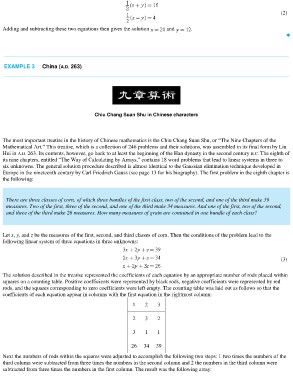
(2)

Adding and subtracting these two equations then gives the solution and .
EXAMPLE 3 China (A.D. 263)

                                                         Chiu Chang Suan Shu in Chinese characters

The most important treatise in the history of Chinese mathematics is the Chiu Chang Suan Shu, or “The Nine Chapters of the
Mathematical Art.” This treatise, which is a collection of 246 problems and their solutions, was assembled in its final form by Liu
Hui in A.D. 263. Its contents, however, go back to at least the beginning of the Han dynasty in the second century B.C. The eighth of
its nine chapters, entitled “The Way of Calculating by Arrays,” contains 18 word problems that lead to linear systems in three to
six unknowns. The general solution procedure described is almost identical to the Gaussian elimination technique developed in
Europe in the nineteenth century by Carl Friedrich Gauss (see page 13 for his biography). The first problem in the eighth chapter is
the following:

 There are three classes of corn, of which three bundles of the first class, two of the second, and one of the third make 39
 measures. Two of the first, three of the second, and one of the third make 34 measures. And one of the first, two of the second,
 and three of the third make 26 measures. How many measures of grain are contained in one bundle of each class?

Let x, y, and z be the measures of the first, second, and third classes of corn. Then the conditions of the problem lead to the
following linear system of three equations in three unknowns:

                                                                                                                                                          (3)

The solution described in the treatise represented the coefficients of each equation by an appropriate number of rods placed within
squares on a counting table. Positive coefficients were represented by black rods, negative coefficients were represented by red
rods, and the squares corresponding to zero coefficients were left empty. The counting table was laid out as follows so that the
coefficients of each equation appear in columns with the first equation in the rightmost column:

                                                                        123

                                                                        232

                                                                        311

                                                                       26 34 39
Next the numbers of rods within the squares were adjusted to accomplish the following two steps: 1 two times the numbers of the
third column were subtracted from three times the numbers in the second column and 2 the numbers in the third column were
subtracted from three times the numbers in the first column. The result was the following array:

