


Page 900 - Elementary_Linear_Algebra_with_Applications_Anton__9_edition
P. 900
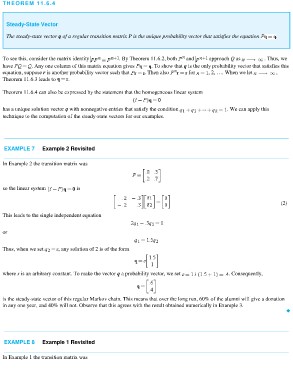
THEOREM 11.6.4

Steady-State Vector                                                                                                      .
The steady-state vector q of a regular transition matrix P is the unique probability vector that satisfies the equation

To see this, consider the matrix identity      . By Theorem 11.6.2, both and              approach Q as                  . Thus, we

have  . Any one column of this matrix equation gives         . To show that q is the only probability vector that satisfies this

equation, suppose r is another probability vector such that  . Then also             for , 2, …. When we let             ,

Theorem 11.6.3 leads to .

Theorem 11.6.4 can also be expressed by the statement that the homogeneous linear system

has a unique solution vector q with nonnegative entries that satisfy the condition        . We can apply this
technique to the computation of the steady-state vectors for our examples.

EXAMPLE 7 Example 2 Revisited
In Example 2 the transition matrix was

so the linear system       is

                                                                                                                            (2)

This leads to the single independent equation

or

Thus, when we set     , any solution of 2 is of the form

where s is an arbitrary constant. To make the vector q a probability vector, we set       . Consequently,

is the steady-state vector of this regular Markov chain. This means that over the long run, 60% of the alumni will give a donation
in any one year, and 40% will not. Observe that this agrees with the result obtained numerically in Example 3.

EXAMPLE 8 Example 1 Revisited
In Example 1 the transition matrix was

