


Page 895 - Elementary_Linear_Algebra_with_Applications_Anton__9_edition
P. 895
at the subsequent observation times.                                                                    .
THEOREM 11.6.1

  If P is the transition matrix of a Markov chain and is the state vector at the nth observation, then

The proof of this theorem involves ideas from probability theory and will not be given here. From this theorem, it follows that

In this way, the initial state vector and the transition matrix P determine for , 2, ….

EXAMPLE 3 Example 2 Revisited
The transition matrix in Example 2 was

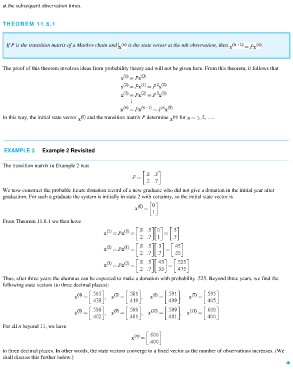
We now construct the probable future donation record of a new graduate who did not give a donation in the initial year after
graduation. For such a graduate the system is initially in state 2 with certainty, so the initial state vector is

From Theorem 11.6.1 we then have

Thus, after three years the alumnus can be expected to make a donation with probability .525. Beyond three years, we find the
following state vectors (to three decimal places):

For all n beyond 11, we have

to three decimal places. In other words, the state vectors converge to a fixed vector as the number of observations increases. (We
shall discuss this further below.)

