


Page 899 - Elementary_Linear_Algebra_with_Applications_Anton__9_edition
P. 899
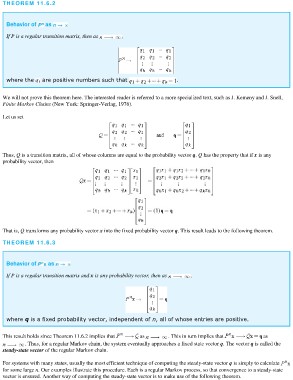
THEOREM 11.6.2                                       ,

  Behavior of as
  If P is a regular transition matrix, then as

where the are positive numbers such that                                      .

We will not prove this theorem here. The interested reader is referred to a more specialized text, such as J. Kemeny and J. Snell,
Finite Markov Chains (New York: Springer-Verlag, 1976).

Let us set

Thus, Q is a transition matrix, all of whose columns are equal to the probability vector q. Q has the property that if x is any
probability vector, then

That is, Q transforms any probability vector x into the fixed probability vector q. This result leads to the following theorem.
THEOREM 11.6.3

Behavior of as                                                                   ,
If P is a regular transition matrix and x is any probability vector, then as

where q is a fixed probability vector, independent of n, all of whose entries are positive.

This result holds since Theorem 11.6.2 implies that     as . This in turn implies that       as

. Thus, for a regular Markov chain, the system eventually approaches a fixed state vector q. The vector q is called the

steady-state vector of the regular Markov chain.

For systems with many states, usually the most efficient technique of computing the steady-state vector q is simply to calculate
for some large n. Our examples illustrate this procedure. Each is a regular Markov process, so that convergence to a steady-state
vector is ensured. Another way of computing the steady-state vector is to make use of the following theorem.

