


Page 898 - Elementary_Linear_Algebra_with_Applications_Anton__9_edition
P. 898
n

                                         0 1 2 3 4 5 10 15 20 22
                                         0 .000 .133 .104 .131 .125 .138 .142 .143 .143
                                         0 .250 .146 .152 .124 .121 .108 .107 .107 .107

Limiting Behavior of the State Vectors

In our examples we saw that the state vectors approached some fixed vector as the number of observations increased. We now ask
whether the state vectors always approach a fixed vector in a Markov chain. A simple example shows that this is not the case.

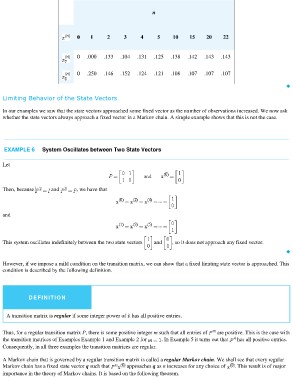
EXAMPLE 6 System Oscillates between Two State Vectors
Let
Then, because and , we have that

and

This system oscillates indefinitely between the two state vectors and , so it does not approach any fixed vector.

However, if we impose a mild condition on the transition matrix, we can show that a fixed limiting state vector is approached. This
condition is described by the following definition.

DEFINITION

A transition matrix is regular if some integer power of it has all positive entries.

Thus, for a regular transition matrix P, there is some positive integer m such that all entries of are positive. This is the case with

the transition matrices of Examples Example 1 and Example 2 for           . In Example 5 it turns out that has all positive entries.

Consequently, in all three examples the transition matrices are regular.

A Markov chain that is governed by a regular transition matrix is called a regular Markov chain. We shall see that every regular

Markov chain has a fixed state vector q such that  approaches q as n increases for any choice of . This result is of major

importance in the theory of Markov chains. It is based on the following theorem.

