


Page 76 - Lecture Notes DCC3113
P. 76
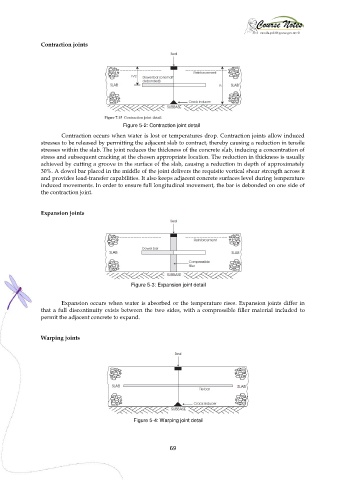
Contraction joints


                                            Figure 5-2: Contraction joint detail

                       Contraction occurs when water is lost or temperatures drop. Contraction joints allow induced
                                                        Work
               stresses to be released by permitting the adjacent slab to contract, thereby causing a reduction in tensile
               stresses within the slab. The joint reduces the thickness of the concrete slab, inducing a concentration of
               stress and subsequent cracking at the chosen appropriate location. The reduction in thickness is usually
               achieved by cutting a groove in the surface of the slab, causing a reduction in depth of approximately
               30%. A dowel bar placed in the middle of the joint delivers the requisite vertical shear strength across it
               and provides load-transfer capabilities. It also keeps adjacent concrete surfaces level during temperature
               induced movements. In order to ensure full longitudinal movement, the bar is debonded on one side of
               the contraction joint.


               Expansion joints


                                               Figure 5-3: Expansion joint detail

                                                          Work
                       Expansion occurs when water is absorbed or the temperature rises. Expansion joints differ in
               that  a  full  discontinuity  exists  between  the  two  sides,  with  a  compressible  filler  material  included  to
               permit the adjacent concrete to expand.


               Warping joints


                                                Figure 5-4: Warping joint detail

                                                          Work


                                                             69

