


Page 130 - C:\Users\trainee\AppData\Local\Temp\msoEAA3.tmp
P. 130
Fundamentals of Stress and Vibration 1. Mathematics for Structural mechanics
[A Practical guide for aspiring Designers / Analysts]
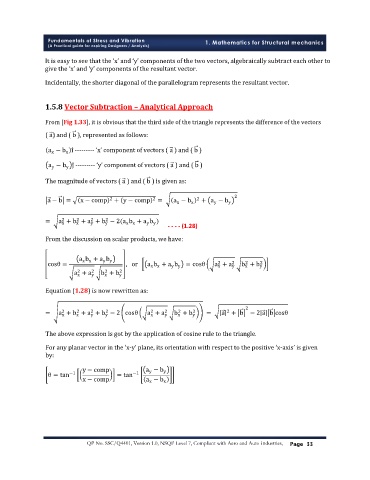
It is easy to see that the ‘x’ and ‘y’ components of the two vectors, algebraically subtract each other to
give the ‘x’ and ‘y’ components of the resultant vector.
Incidentally, the shorter diagonal of the parallelogram represents the resultant vector.
ͳǤͷǤͺ
–
ȏ ͳǤ͵͵Ȑǡ
( a ) and ( b ), represented as follows:
a − b i --------- ‘x’ component of vectors ( a ) and ( b )
x
x
a − b j --------- ‘y’ component of vectors ( a ) and ( b )
y
y
The magnitude of vectors ( a ) and ( b ) is given as:
2
a − b = x − comp + y − comp = a − b + a − b
2
2
2
y
y
x
x
= a + b + a + b − 2(a b + a b )
2
2
2
2
y y
x x
y
y
x
x
- - - - (1.28)
From the discussion on scalar products, we have:
a b + a b
cosθ = x x y y , or a b + a b = cosθ a + a b + b
2
2
2
2
y
y y
x
x
x x
y
a + a b + b 2
2
2
2
x y x y
Equation (1.28) is now rewritten as:
2
= a + b + a + b − 2 cosθ a + a b + b = a + b − 2 a b cosθ
2
2
2
2
2
2
2
2
2
y
y
y
x
x
x
x
y
The above expression is got by the application of cosine rule to the triangle.
For any planar vector in the ‘x-y’ plane, its orientation with respect to the positive ‘x-axis’ is given
by:
y − comp a − b
y
y
θ = tan −1 = tan −1
x − comp a − b
x
x
QP No. SSC/Q4401, Version 1.0, NSQF Level 7, Compliant with Aero and Auto Industries, Page 33

