


Page 151 - C:\Users\trainee\AppData\Local\Temp\msoEAA3.tmp
P. 151
Fundamentals of Stress and Vibration
[A Practical guide for aspiring Designers / Analysts] 1. Mathematics for Structural mechanics
Now, let us consider a ‘zyx’ transformation, meaning, the first rotation is about the ‘z-axis’, the second
rotation is about the ‘y-axis’ and the final rotation is about the ‘x-axis’.
This is mathematically represented as follows:
x
Rotation Rotation Rotation y
y
x
z
z
x x′
= R R R y = y′
y
x
z
z z′
1 0 0 cosθ 0 −sinθ cos θ sin θ 0 x x ′
′
= 0 cos θ sinθ 0 1 0 − sinθ cos θ 0 y = y - - - - (1.59)
0 − sin θ cos θ sinθ 0 cosθ 0 0 1 z z ′
Equation (1.59) could be used to transform the basis vectors as well:
1 0 0 cos θ 0 −sinθ cos θ sin θ 0 e 1 e ′ 1
′
0 cosθ sinθ 0 1 0 − sinθ cos θ 0 e 2 = e - - - - (1.60)
2
0 − sin θ cos θ sin θ 0 cos θ 0 0 1 e 3 e ′
3
Note: the above transformation matrices are valid, given that, the vector length is preserved.
Let us now consider a situation that involves shear distortion transformation.
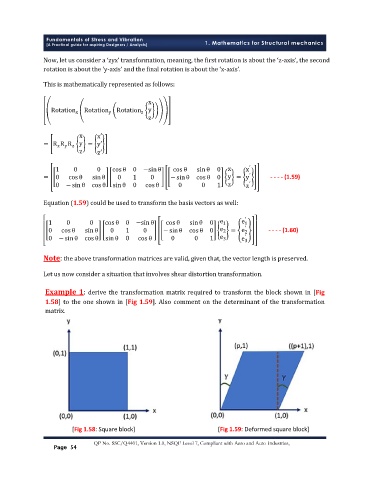
ͳǣ
ȏ
ͳǤͷͺȐ ȏ ͳǤͷͻȐǤ
Ǥ
[Fig 1.58: Square block] [Fig 1.59: Deformed square block]
QP No. SSC/Q4401, Version 1.0, NSQF Level 7, Compliant with Aero and Auto Industries,
Page 54

