


Page 152 - C:\Users\trainee\AppData\Local\Temp\msoEAA3.tmp
P. 152
Fundamentals of Stress and Vibration                1. Mathematics for Structural mechanics
                 [A Practical guide for aspiring Designers / Analysts]
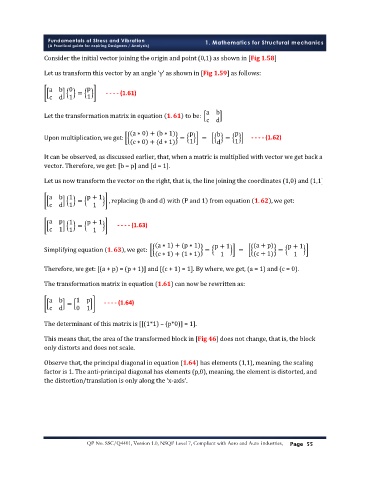
                Consider the initial vector joining the origin and point (0,1) as shown in [Fig 1.58]

                Let us transform this vector by an angle ‘γ’ as shown in [Fig 1.59] as follows:


                 a b 0        p
                            =        - - - - (1.61)
                 c   d 1      1
                                                                     a   b
                Let the transformation matrix in equation    .       to be:
                                                                     c   d

                                             a ∗ 0  + (b ∗ 1)   p        b     p
                Upon multiplication, we get:                 =      =       =       - - - - (1.62)
                                             c ∗ 0  + (d ∗ 1)   1        d     1

                It can be observed, as discussed earlier, that, when a matric is multiplied with vector we get back a
                vector. Therefore, we get: [b = p] and [d = 1].

                Let us now transform the vector on the right, that is, the line joining the coordinates (1,0) and (1,1).


                 a b 1        p + 1
                            =         , replacing  b and d  with  P and 1  from equation    .      , we get:
                 c   d 1        1

                 a p 1        p + 1
                            =           - - - - (1.63)
                 c   1 1        1

                                                     a ∗ 1  + (p ∗ 1)   p + 1        (a + p)    p + 1
                Simplifying equation    .      , we get:             =          =             =
                                                     c ∗ 1  + (1 ∗ 1)     1          (c + 1)      1

                Therefore, we get: [(a + p) = (p + 1)] and [(c + 1) = 1]. By where, we get, (a = 1) and (c = 0).

                The transformation matrix in equation (1.61) can now be rewritten as:

                 a b      1   p
                        =           - - - - (1.64)
                 c   d    0   1

                The determinant of this matrix is [[(1*1) – (p*0)] = 1].

                This means that, the area of the transformed block in [Fig 46] does not change, that is, the block
                only distorts and does not scale.

                Observe that, the principal diagonal in equation (1.64) has elements (1,1), meaning, the scaling
                factor is 1. The anti-principal diagonal has elements (p,0), meaning, the element is distorted, and
                the distortion/translation is only along the ‘x-axis’.


                              QP No. SSC/Q4401, Version 1.0, NSQF Level 7, Compliant with Aero and Auto Industries,   Page 55

