


Page 21 - C:\Users\trainee\AppData\Local\Temp\msoEAA3.tmp
P. 21
Document Title
Fundamentals of Stress and Vibration 2. Engineering Mechanics Chapter
[A Practical guide for aspiring Designers / Analysts]
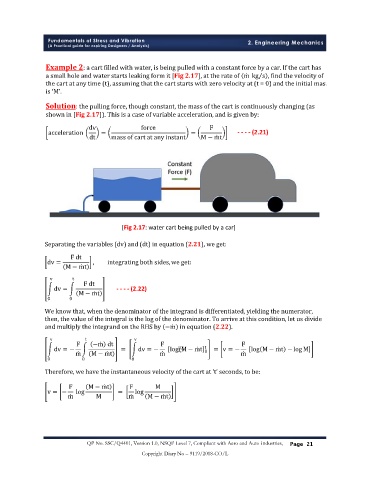
Example 2: a cart filled with water, is being pulled with a constant force by a car. If the cart has
a small hole and water starts leaking form it [Fig 2.17], at the rate of m kg s , find the velocity of
the cart at any time (t), assuming that the cart starts with zero velocity at (t = 0) and the initial mass
is ‘M’.
Solution: the pulling force, though constant, the mass of the cart is continuously changing (as
shown in [Fig 2.17]). This is a case of variable acceleration, and is given by:
dv force F
acceleration dt = mass of cart at any instant = M − m t - - - - (2.21)
[Fig 2.17: water cart being pulled by a car]
Separating the variables (dv) and (dt) in equation (2.21), we get:
F dt
dv = , integrating both sides, we get:
M − m t
v t
F dt
dv = - - - - (2.22)
M − m t
0 0
We know that, when the denominator of the integrand is differentiated, yielding the numerator,
then, the value of the integral is the log of the denominator. To arrive at this condition, let us divide
and multiply the integrand on the RHS by −m in equation (2.22).
v t v
F −m dt F F
t
dv = − m M − m t = dv = − m log(M − m t = v = − m log M − m t − log M
0
0 0 0
Therefore, we have the instantaneous velocity of the cart at ‘t’ seconds, to be:
F M − m t F M
v = − log = log
m M m M − m t
QP No. SSC/Q4401, Version 1.0, NSQF Level 7, Compliant with Aero and Auto Industries, Page 21 age 21
P
Copyright Diary No – 9119/2018-CO/L

