


Page 19 - C:\Users\trainee\AppData\Local\Temp\msoEAA3.tmp
P. 19
Document Title
                 Fundamentals of Stress and Vibration                              2. Engineering Mechanics   Chapter
                 [A Practical guide for aspiring Designers / Analysts]


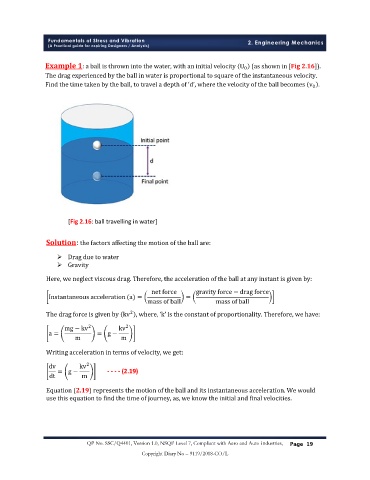
                Example 1: a ball is thrown into the water, with an initial velocity  U   (as shown in [Fig 2.16]).
                                                                                  0
                The drag experienced by the ball in water is proportional to square of the instantaneous velocity.
                Find the time taken by the ball, to travel a depth of ‘d’, where the velocity of the ball becomes  v  .
                                                                                                        0


                        [Fig 2.16: ball travelling in water]

                Solution: the factors affecting the motion of the ball are:

                    Ø  Drag due to water
                    Ø  Gravity

                Here, we neglect viscous drag. Therefore, the acceleration of the ball at any instant is given by:

                                                   net force      gravity force − drag force
                 Instantaneous acceleration (a) =              =
                                                  mass of ball          mass of ball
                The drag force is given by  kv  , where, ‘k’ is the constant of proportionality. Therefore, we have:
                                            2
                      mg − kv 2         kv 2
                 a =             =  g −
                          m              m

                Writing acceleration in terms of velocity, we get:

                 dv        kv 2
                    =  g −           - - - - (2.19)
                 dt         m

                Equation (2.19) represents the motion of the ball and its instantaneous acceleration. We would
                use this equation to find the time of journey, as, we know the initial and final velocities.


                              QP No. SSC/Q4401, Version 1.0, NSQF Level 7, Compliant with Aero and Auto Industries,   P
                                                                                                 Page 19 age 19
                                                Copyright Diary No – 9119/2018-CO/L

