


Page 22 - C:\Users\trainee\AppData\Local\Temp\msoEAA3.tmp
P. 22
Document Title
Fundamentals of Stress and Vibration Chapter Title
[A Practical guide for aspiring Designers / Analysts] 2. Engineering Mechanics
͵ǣ
Ǥ
ͳͲͲ ȀǤ
Ǥ
ͳͲͲ Ȁ
ǡ ǣ
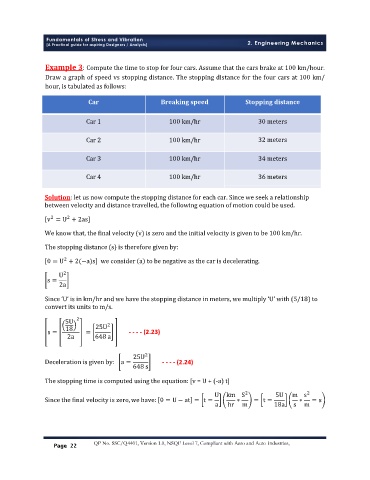
Car Breaking speed Stopping distance
Car 1 100 km/hr 30 meters
Car 2 100 km/hr 32 meters
Car 3 100 km/hr 34 meters
Car 4 100 km/hr 36 meters
Solution: let us now compute the stopping distance for each car. Since we seek a relationship
between velocity and distance travelled, the following equation of motion could be used.
v = U + 2as
2
2
We know that, the final velocity (v) is zero and the initial velocity is given to be 100 km/hr.
The stopping distance (s) is therefore given by:
2
0 = U + 2(−a)s we consider a to be negative as the car is decelerating.
U 2
s =
2a
Since ‘U’ is in km/hr and we have the stopping distance in meters, we multiply ‘U’ with (5/18) to
convert its units to m/s.
5U 2
18 25U 2
s = = - - - - (2.23)
2a 648 a
25U 2
Deceleration is given by: a = - - - - (2.24)
648 s
The stopping time is computed using the equation: [v = U + (-a) t]
U km S 2 5U m s 2
Since the final velocity is zero, we have: 0 = U − at = t = ∗ = t = ∗ = s
a hr m 18a s m
Page 22 QP No. SSC/Q4401, Version 1.0, NSQF Level 7, Compliant with Aero and Auto Industries,

