


Page 28 - C:\Users\trainee\AppData\Local\Temp\msoEAA3.tmp
P. 28
Document Title
                Fundamentals of Stress and Vibration                                  Chapter Title
                [A Practical guide for aspiring Designers / Analysts]              2. Engineering Mechanics


                From [Fig 2.21], it can be seen that, the slope of the curve is zero at minimum ‘H’, therefore, we
                have:

                                         2 sinθ        100          sin θ       5
                              2
                 0 = −100 sec θ + 80 ∗            =         = 160            =   = tan θ
                                                         2
                                                                       3
                                            3
                                         cos θ        cos θ         cos θ       8
                Therefore, we have  θ = 32.005
                                              0
                It can be observed that the value of ‘θ’ for minimum ‘H’ via XLS, as shown in [Fig 2.21], is close to
                the exact value.
                                                             L           100
                The time of flight for equation    .       is:  t =  =           = 4.72 s
                                                           V cos θ  25 cos 32.005

                It can be shown that, the range of 100 m (given) is maximum for the computed ‘H’ and ‘θ’.


                Example 5: For (Example 4) establish a general expression for maximum range (R) of the
                projectile.

                Solution 5: For the given situation, the following example computes the expression for
                maximum range:

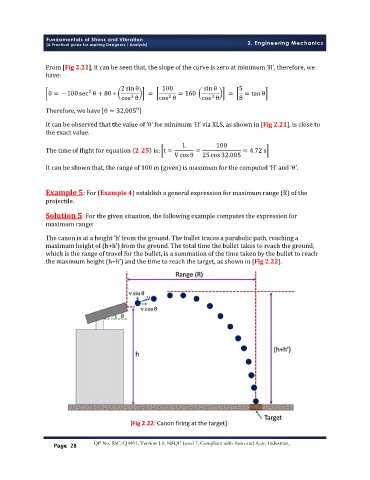
                The canon is at a height ‘h’ from the ground. The bullet traces a parabolic path, reaching a
                maximum height of (h+h’) from the ground. The total time the bullet takes to reach the ground,
                which is the range of travel for the bullet, is a summation of the time taken by the bullet to reach
                the maximum height (h+h’) and the time to reach the target, as shown in [Fig 2.22].


                                            [Fig 2.22: Canon firing at the target]


                   Page 28      QP No. SSC/Q4401, Version 1.0, NSQF Level 7, Compliant with Aero and Auto Industries,

