


Page 29 - C:\Users\trainee\AppData\Local\Temp\msoEAA3.tmp
P. 29
Document Title
                 Fundamentals of Stress and Vibration                              2. Engineering Mechanics   Chapter
                 [A Practical guide for aspiring Designers / Analysts]


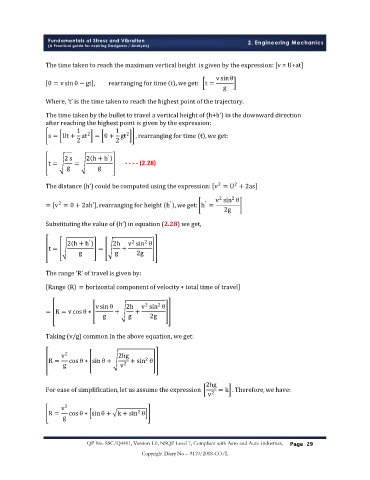
                  The time taken to reach the maximum vertical height  is given by the expression: [v = U+at]

                                                                        v sinθ
                   0 = v sinθ − gt ,  rearranging for time  t , we get:    t =
                                                                           g

                Where, ‘t’ is the time taken to reach the highest point of the trajectory.

                The time taken by the bullet to travel a vertical height of (h+h’) in the downward direction
                after reaching the highest point is given by the expression:
                          1            1
                                           2
                              2
                 s =  Ut + at   =  0 + gt    , rearranging for time  t , we get:
                          2            2
                      2 s     2 h + h
                                     ′
                 t =      =               - - - - (2.28)
                       g         g

                                                                               2
                  The distance (h’) could be computed using the expression:  v = U + 2as
                                                                         2
                                                                              2
                                                                          2
                                                                        v sin θ
                    2
                                                                     ′
                                                         ′
                =  v = 0 + 2ah′ , rearranging for height  h  , we get:  h =
                                                                           2g

                Substituting the value of (h’) in equation (2.28) we get,

                       2 h + h        2h   v sin θ
                              ′
                                                 2
                                             2
                   t =            =      +
                           g           g      2g

                The range ‘R’ of travel is given by:

                 Range  R  = horizontal component of velocity ∗ total time of travel

                                                 2
                                 v sinθ    2h   v sin θ
                                                     2
                =  R = v cos θ ∗       +      +
                                   g       g       2g

                  Taking (v/g) common in the above equation, we get:

                     v 2                2hg
                                                 2
                 R =    cos θ ∗  sinθ +     + sin θ
                      g                  v 2
                                                                     2hg
                For ease of simplification, let us assume the expression     2  = k  . Therefore, we have:
                                                                      v

                     v 2
                                               2
                   R =  cos θ ∗  sinθ +  k + sin θ
                      g


                              QP No. SSC/Q4401, Version 1.0, NSQF Level 7, Compliant with Aero and Auto Industries,   Page 29 age 29
                                                                                                 P
                                                Copyright Diary No – 9119/2018-CO/L

