


Page 36 - C:\Users\trainee\AppData\Local\Temp\msoEAA3.tmp
P. 36
Document Title
                Fundamentals of Stress and Vibration                                  Chapter Title
                [A Practical guide for aspiring Designers / Analysts]              2. Engineering Mechanics


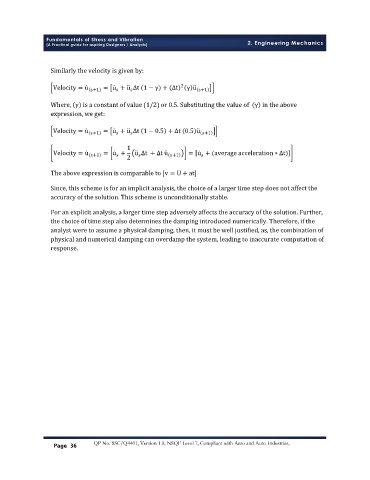
                  Similarly the velocity is given by:

                                                             2
                   Velocity = u   s+1  =  u  + u  ∆t  1 − γ  +  ∆t   γ u   s+1
                                            s
                                       s

                  Where,  γ  is a constant of value (1/2) or 0.5. Substituting the value of   γ  in the above
                   expression, we get:

                   Velocity = u   s+1  =  u  + u  ∆t  1 − 0.5  + ∆t  0.5 u   s+1
                                            s
                                       s

                                           1
                   Velocity = u   s+1  =  u  +  u  ∆t  + ∆t u   s+1     =  u  + (average acceleration ∗ ∆t)
                                        s  2   s                    s

                  The above expression is comparable to [v = U + at]

                  Since, this scheme is for an implicit analysis, the choice of a larger time step does not affect the
                  accuracy of the solution. This scheme is unconditionally stable.

                  For an explicit analysis, a larger time step adversely affects the accuracy of the solution. Further,

                  the choice of time step also determines the damping introduced numerically. Therefore, if the
                   analyst were to assume a physical damping, then, it must be well justified, as, the combination of
                  physical and numerical damping can overdamp the system, leading to inaccurate computation of
                  response.


                   Page 36      QP No. SSC/Q4401, Version 1.0, NSQF Level 7, Compliant with Aero and Auto Industries,

