


Page 35 - C:\Users\trainee\AppData\Local\Temp\msoEAA3.tmp
P. 35
Document Title
                 Fundamentals of Stress and Vibration                              2. Engineering Mechanics   Chapter
                 [A Practical guide for aspiring Designers / Analysts]


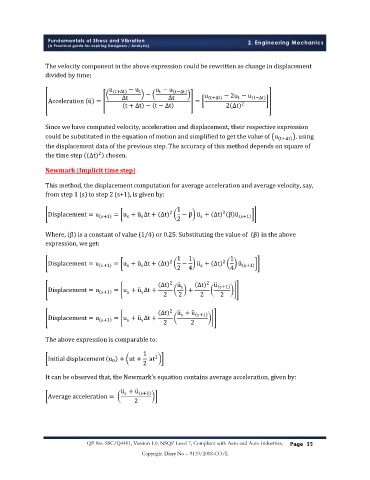
                  The velocity component in the above expression could be rewritten as change in displacement
                divided by time;

                                     u (t+∆t)  − u t  u − u  t−∆t
                                         ∆t       −    t  ∆t         u     − 2u − u  t−∆t
                 Acceleration  u   =                              =    (t+∆t)   t  2
                                           t + ∆t  −  t − ∆t                2 ∆t

                  Since we have computed velocity, acceleration and displacement, their respective expression
                could be substituted in the equation of motion and simplified to get the value of  u  t+∆t   , using

                the displacement data of the previous step. The accuracy of this method depends on square of
                  the time step   ∆t    chosen.
                                  2
                  Newmark (Implicit time step)

                  This method, the displacement computation for average acceleration and average velocity, say,
                from step 1 (s) to step 2 (s+1), is given by:

                                                            1
                                                                           2
                                                         2
                   Displacement = u  s+1  =  u + u  ∆t +  ∆t    − β  u  +  ∆t   β u   s+1
                                                s
                                           s
                                                            2      s

                Where,  β  is a constant of value (1/4) or 0.25. Substituting the value of   β  in the above
                expression, we get:

                                                                             1
                                                               1
                                                            1
                   Displacement = u  s+1  =  u + u  ∆t +  ∆t    −   u  +  ∆t      u   s+1
                                                                           2
                                                         2
                                           s
                                                s
                                                            2  4   s         4

                                                      ∆t  2  u    ∆t  2  u   s+1
                                                             s
                   Displacement = u  s+1  =  u + u  ∆t +       +
                                           s
                                                s
                                                       2    2      2      2

                                                      ∆t  2  u  + u   s+1
                                                             s
                 Displacement = u  s+1  =  u + u  ∆t +  2       2

                                                s
                                           s

                The above expression is comparable to:
                                                1
                 Initial displacement  u   +  ut +  at
                                                    2
                                      0
                                                2
                It can be observed that, the Newmark’s equation contains average acceleration, given by:

                                          s
                                         u  + u   s+1
                   Average acceleration =
                                             2


                              QP No. SSC/Q4401, Version 1.0, NSQF Level 7, Compliant with Aero and Auto Industries,   P
                                                                                                 Page 35 age 35
                                                Copyright Diary No – 9119/2018-CO/L

