Page 37 - C:\Users\trainee\AppData\Local\Temp\msoEAA3.tmp
P. 37
Document Title
                 Fundamentals of Stress and Vibration                              2. Engineering Mechanics   Chapter
                 [A Practical guide for aspiring Designers / Analysts]


                ʹǤ͸  ‡™–‘ǯ•  ƒ™• ‘ˆ  ‘–‹‘

                 ƒ› ‘ˆ –Ї „ƒ•‹… ‡‰‹‡‡”‹‰ ’”‘„އ• …ƒ „‡ •‘Ž˜‡† —•‹‰ –Ї  ‡™–‘ǯ• Žƒ™• ‘ˆ ‘–‹‘Ǥ  Ї
                ‘•– …‘‘ ƒ’’Ž‹…ƒ–‹‘• ƒ”‡ǣ
                       ·   ‡Š‹…އ †›ƒ‹…•
                       ·   ‡…Šƒ‹••
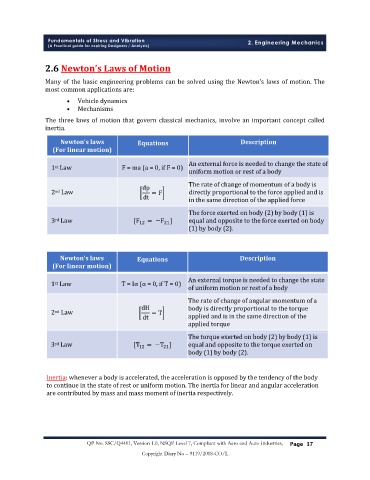
                 Ї –Š”‡‡ Žƒ™• ‘ˆ ‘–‹‘ –Šƒ– ‰‘˜‡” …Žƒ••‹…ƒŽ ‡…Šƒ‹…•ǡ ‹˜‘Ž˜‡ ƒ ‹’‘”–ƒ– …‘…‡’– …ƒŽŽ‡†
                ‹‡”–‹ƒǤ
                     Newton’s laws             Equations                         Description
                  (For linear motion)

                                                               An external force is needed to change the state of
                  1  Law                 F = ma (a = 0, if F = 0)
                   st
                                                               uniform motion or rest of a body
                                                               The rate of change of momentum of a body is
                                                dp
                  2  Law                           = F         directly proportional to the force applied and is
                   nd
                                                dt             in the same direction of the applied force
                                                               The force exerted on body (2) by body (1) is
                  3  Law                     [F 12  = −F ]     equal and opposite to the force exerted on body
                   rd
                                                       21
                                                               (1) by body (2).


                     Newton’s laws            Equations                         Description
                  (For linear motion)

                                                               An external torque is needed to change the state
                  1  Law                 T = Iα (α = 0, if T = 0)
                   st
                                                               of uniform motion or rest of a body
                                                               The rate of change of angular momentum of a
                                                dH             body is directly proportional to the torque
                  2  Law                           = T
                   nd
                                                dt             applied and is in the same direction of the
                                                               applied torque
                                                               The torque exerted on body (2) by body (1) is
                  3  Law                     [T 12  = −T ]     equal and opposite to the torque exerted on
                   rd
                                                       21
                                                               body (1) by body (2).


                Inertia: whenever a body is accelerated, the acceleration is opposed by the tendency of the body
                to continue in the state of rest or uniform motion. The inertia for linear and angular acceleration
                are contributed by mass and mass moment of inertia respectively.


                              QP No. SSC/Q4401, Version 1.0, NSQF Level 7, Compliant with Aero and Auto Industries,   Page 37 age 37
                                                                                                 P
                                                Copyright Diary No – 9119/2018-CO/L
   32   33   34   35   36   37   38   39   40   41   42