


Page 70 - C:\Users\trainee\AppData\Local\Temp\msoEAA3.tmp
P. 70
Document Title
Fundamentals of Stress and Vibration Chapter Title
[A Practical guide for aspiring Designers / Analysts] 2. Engineering Mechanics
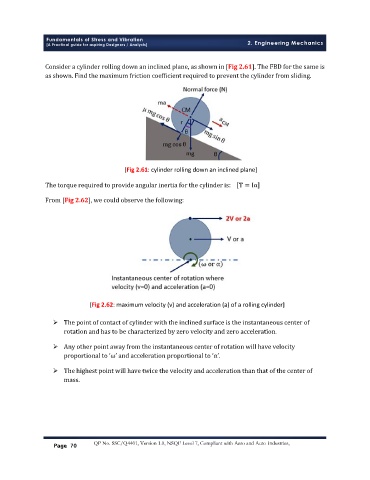
ǡ ȏ ʹǤͳȐǤ
Ǥ
ϐ
Ǥ
[Fig 2.61: cylinder rolling down an inclined plane]
The torque required to provide angular inertia for the cylinder is: T = Iα
From [Fig 2.62], we could observe the following:
[Fig 2.62: maximum velocity (v) and acceleration (a) of a rolling cylinder]
Ø The point of contact of cylinder with the inclined surface is the instantaneous center of
rotation and has to be characterized by zero velocity and zero acceleration.
Ø Any other point away from the instantaneous center of rotation will have velocity
proportional to ‘ω’ and acceleration proportional to ‘α’.
Ø The highest point will have twice the velocity and acceleration than that of the center of
mass.
Page 70 QP No. SSC/Q4401, Version 1.0, NSQF Level 7, Compliant with Aero and Auto Industries,

