


Page 75 - C:\Users\trainee\AppData\Local\Temp\msoEAA3.tmp
P. 75
Document Title
                 Fundamentals of Stress and Vibration                              2. Engineering Mechanics   Chapter
                 [A Practical guide for aspiring Designers / Analysts]

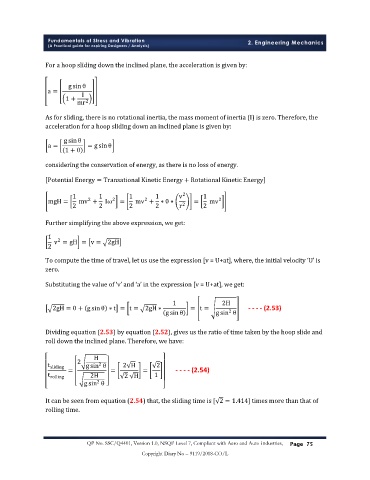
                For a hoop sliding down the inclined plane, the acceleration is given by:


                        g sin θ
                  a =
                       1 +  I
                           mr 2
                As for sliding, there is no rotational inertia, the mass moment of inertia (I) is zero. Therefore, the
                acceleration for a hoop sliding down an inclined plane is given by:

                      g sinθ
                 a =           = g sin θ
                       1 + 0

                considering the conservation of energy, as there is no loss of energy.

                 Potential Energy = Transational Kinetic Energy + Rotational Kinetic Energy


                         1        1         1       1       v 2     1
                                      2
                                                 2
                                                                         2
                              2
                 mgH =    mv +  Iω   =    mv + ∗ 0 ∗             =    mv
                         2        2         2       2       r 2     2
                Further simplifying the above expression, we get:
                 1
                   v = gH  =  v =  2gH
                    2
                 2
                To compute the time of travel, let us use the expression [v = U+at], where, the initial velocity ‘U’ is
                zero.

                Substituting the value of ‘v’ and ‘a’ in the expression [v = U+at], we get:


                                                          1               2H
                  2gH = 0 +  g sinθ  ∗ t  =  t =  2gH ∗          =  t =            - - - - (2.53)
                                                                             2
                                                        g sinθ          g sin θ

                Dividing equation (2.53) by equation (2.52), gives us the ratio of time taken by the hoop slide and
                roll down the inclined plane. Therefore, we have:

                           2    H
                                  2
                  t sliding     g sin θ    2 H      2
                  t     =      2H      =    2  H   =    1       - - - - (2.54)

                   rolling       2
                             g sin θ
                It can be seen from equation (2.54) that, the sliding time is [ 2 = 1.414] times more than that of
                rolling time.


                              QP No. SSC/Q4401, Version 1.0, NSQF Level 7, Compliant with Aero and Auto Industries,   Page 75 age 75
                                                                                                 P
                                                Copyright Diary No – 9119/2018-CO/L

