


Page 118 - Fisika Terapan for Engineers and Scientists
P. 118
318                                CHAPTER 10  Systems of Particles


                        (a)             This fraction of the total          (b)
                                        mass, dm/M, is the same  a
                                        as this fraction of the total  y =    x
                                                                b
                                                     1
                                        area, y dx/( ab).                                              1  b
                                               2                                                       3
                            y                                                   y
                                           dm
                                                        a
                                                   dx                       y CM
                                                                                                                 1  a
                                                                                                                 3
                                                                  x                                                  x
                                           b
                                                                                                   x CM
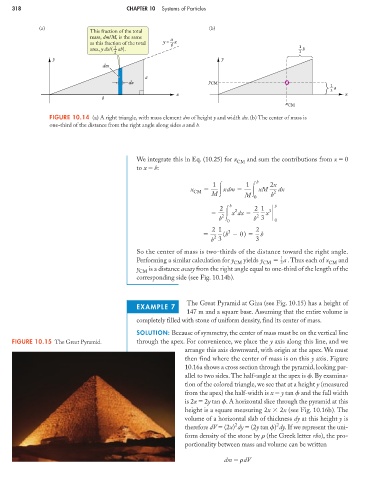
                           FIGURE 10.14 (a) A right triangle, with mass element dm of height y and width dx. (b) The center of mass is
                           one-third of the distance from the right angle along sides a and b.


                                                      We integrate this in Eq. (10.25) for x  and sum the contributions from x   0
                                                                                    CM
                                                      to x   b:

                                                                             1         1  b   2x
                                                                          x CM       x dm       xM  2  dx
                                                                            M          M  0   b
                                                                               2  b       2 1  3  b
                                                                                2   x dx    2   x `
                                                                                    2
                                                                               b  0      b 3    0
                                                                             2 1  3       2
                                                                                (b   0)    b
                                                                             2
                                                                            b 3           3
                                                      So the center of mass is two-thirds of the distance toward the right angle.
                                                                                                 1
                                                      Performing a similar calculation for y  yields y    a  .Thus each of x  and
                                                                                   CM       CM   3              CM
                                                      y  is a distance away from the right angle equal to one-third of the length of the
                                                       CM
                                                      corresponding side (see Fig. 10.14b).

                                                                     The Great Pyramid at Giza (see Fig. 10.15) has a height of
                                                      EXAMPLE 7
                                                                     147 m and a square base. Assuming that the entire volume is
                                                      completely filled with stone of uniform density, find its center of mass.
                                                      SOLUTION: Because of symmetry, the center of mass must be on the vertical line
                FIGURE 10.15 The Great Pyramid.       through the apex. For convenience, we place the y axis along this line, and we
                                                                    arrange this axis downward, with origin at the apex. We must
                                                                    then find where the center of mass is on this y axis. Figure
                                                                    10.16a shows a cross section through the pyramid, looking par-
                                                                    allel to two sides.The half-angle at the apex is  . By examina-
                                                                    tion of the colored triangle, we see that at a height y (measured
                                                                    from the apex) the half-width is x   y tan   and the full width
                                                                    is 2x   2y tan  . A horizontal slice through the pyramid at this
                                                                    height is a square measuring 2x   2x (see Fig. 10.16b). The
                                                                    volume of a horizontal slab of thickness dy at this height y is
                                                                                                2
                                                                                    2
                                                                    therefore dV   (2x) dy   (2y tan  ) dy. If we represent the uni-
                                                                    form density of the stone by   (the Greek letter rho), the pro-
                                                                    portionality between mass and volume can be written
                                                                                dm    dV

